Here we get Interview of Star , politician , Company CEO, Profile all of them, Wallpapers. News About Technology , Reports which published some where , News about Internet
Wednesday, February 16, 2011
12 Indian foods that cut fat
You don't have to acquire a taste for olive oil, seaweed or soya to maintain a low-fat, healthy diet. Indian cuisine can be healthy too, if it's cooked with oil and ingredients that take care of your heart and health.
Ayurveda suggests you include all tastes — sweet, sour, salty, pungent, bitter and astringent — in at least one meal each day, to help balance unnatural cravings. Here are 12 foods that can help you lose weight and gain health:
Turmeric : Curcumin, the active component of turmeric, is an object of research owing to its properties that suggest they may help to turn off certain genes that cause scarring and enlargement of the heart. Regular intake may help reduce low-density lipoprotein (LDL) or bad cholesterol and high blood pressure, increase blood circulation and prevent blood clotting, helping to prevent heart attack.
Cardamom : This is a thermogenic herb that increases metabolism and helps burn body fat. Cardamom is considered one of the best digestive aids and is believed to soothe the digestive system and help the body process other foods more efficiently.
Chillies : Foods containing chillies are said to be as foods that burn fat. Chillies contain capsaicin that helps in increasing the metabolism. Capsaicin is a thermogenic food, so it causes the body to burn calories for 20 minutes after you eat the chillies.
Curry leaves : Incorporating curry leaves into your daily diet can help you lose weight. These leaves flush out fat and toxins, reducing fat deposits that are stored in the body, as well as reducing bad cholesterol levels. If you are overweight, incorporate eight to 10 curry leaves into your diet daily. Chop them finely and mix them into a drink, or sprinkle them over a meal.
Garlic : An effective fat-burning food, garlic contains the sulphur compound allicin which has anti-bacterial effects and helps reduce cholesterol and unhealthy fats.
Mustard oil : This has low saturated fat compared to other cooking oils. It has fatty acid, oleic acid, erucic acid and linoleic acid. It contains antioxidants, essential vitamins and reduces cholesterol, which is good for the heart.
Cabbage : Raw or cooked cabbage inhibits the conversion of sugar and other carbohydrates into fat. Hence, it is of great value in weight reduction.
Moong dal : The bean sprouts are rich in Vitamin A, B, C and E and many minerals, such as calcium, iron and potassium. It is recommended as a food replacement in many slimming programmes, as it has a very low fat content. It is a rich source of protein and fibre, which helps lower blood cholesterol level. The high fibre content yields complex carbohydrates, which aid digestion, are effective in stabilising blood sugar and prevent its rapid rise after meal consumption.
Honey : It is a home remedy for obesity. It mobilises the extra fat deposits in the body allowing it to be utilised as energy for normal functions. One should start with about 10 grams or a tablespoon, taken with hot water early in the morning.
Buttermilk : It is the somewhat sour, residual fluid that is left after butter is churned. The probiotic food contains just 2.2 grams of fat and about 99 calories, as compared to whole milk that contains 8.9 grams fat and 157 calories. Regular intake provides the body with all essential nutrients and does not add fats and calories to the body. It is thus helpful in weight loss.
Millets : Fibre-rich foods such as millets - jowar, bajra, ragi, etc - absorb cholesterol and help increase the secretion of the bile that emulsifies fats.
Cinnamon and cloves: Used extensively in Indian cooking, the spices have been found to improve the function of insulin and to lower glucose, total cholesterol, LDL and triglycerides in people with type 2 diabetes.
Saturday, January 22, 2011
Seven Wonders Of India

The 17.8 m monolith of Jain prophet Bhagavan Gomateshwara Bahubali, which was carved out around 983 C.E and is located in Shravanabelagola, India, is anointed with saffron every 12 years by thousands of devotees as part of the Mahamastakabhisheka festival. The colossal monolithic statue of Gomateshwara (Shravanabelagola is a synonymous word), also called as Bahubali the Jain saint, created around 983 C.E by Chamundaraya, a minister of the Ganga King, Rachamalla (Raachmalla SathyaVaak IV 975-986 C.E) is located atop the Chandragiri hill (618 steps climb leads to the monolith on the hill), near the town of Shravanabelagola in Karnataka state. This statue is said to have been carved out of a single block of fine-grained white granite and is considered of great religious significance because Jains believe Bahubali was the first to attain moksha (freedom from cycle of birth and death). The image stands on a lotus. It has no support up to the thighs and is 60 feet (18 m) tall with the face measuring 6.5 feet (2.0 m). The statue is completely in the nude, in the Jain custom and is visible from a distance of 30 km.With the serene expression on the face of the image, its curled hair with graceful locks, its proportional anatomy, the monolith size, and the combination of its artistry and craftsmanship have led it to be called the mightiest achievement in sculptural art in medieval Karnataka. It is the largest monolithic statue in the world.
The neighbouring areas of Shravanabelagola, apart from the Gomateshwara statue, have Jaina bastis and several images of the Jaina Thirthankaras. A beautiful view of the surrounding areas could be seen from the top of the Chandragiri hill. Every 12 years, thousands of devotees congregate here to perform the Mahamastakabhisheka, a spectacular ceremony in which the thousand-year-old statue is anointed with milk, curds, ghee, saffron and gold coins. The anointing last took place in February 2006, and the next ceremony will occur in 2018.
2. Golden temple or Harmandir Sahib

The Harmandir Sahib (The abode of God) – Golden Temple (main building) Complex with Akal Takht Sahib.completed in August 1604 AD

The Harmandir Sahib (Punjabi) or Darbar Sahib, informally referred to as the Golden Temple or Temple of God, is culturally the most significant shrine of the Sikhs and one of the oldest Sikh Gurudwara. It is located in the city of Amritsar, which was established by Guru Ram Das, the fourth guru of the Sikhs and the city that it was built in, is also due to the shrine known as Amritsar.
The fourth Guru of Sikhism, Guru Ram Das, excavated a tank in 1577 C.E which subsequently became known as Amritsar or Amrit Sarovar (meaning: Pool of the Nectar of Immortality), giving its name to the city that grew around it. In due course, a splendid Sikh edifice, Harmandir Sahib (meaning: The abode of God) [6], rose in the middle of this tank and became the supreme centre of Sikhism. Its sanctum houses the Adi Granth, compiled by Guru Arjun Dev, comprising compositions of Sikh Gurus and other saints considered to have Sikh values and philosophies e.g. Baba Farid, Kabir, etc. . Devotees, for whom the temple is a symbol of freedom and spiritual independence, come here from all over the world to enjoy its environs and offer their prayers. The Golden Temple sits on a rectangular platform, surrounded by a pool of water called the Amrit Sarovar. The temple building has four entrances instead of the usual single entry. This is symbolic of the openness of Sikhism and indicates that followers of all faiths are allowed inside. The walls within are decorated with carved wooden panels and elaborate inlay work in silver and gold. The Adi Granth, rests on a throne beneath a jewel-encrusted canopy. Priests conduct continuous recitation of verses from the holy book.
03. Taj Mahal
Taj Mahal, built in the memory of the queen Mumtaz Mahal

Taj Mahal (also "the Taj"), the pinnacle of Mughal architecture, * Archeological Survey of India description was built by the Mughal emperor Shah Jahan in memory of his queen Mumtaz Mahal. It is considered the finest example of Mughal architecture, a style that combines elements from Persian, Turkish, Indian, and Islamic architectural styles. In 1983, the Taj Mahal became a UNESCO World Heritage Site and was cited as "the jewel of Muslim art in India and one of the universally admired masterpieces of the world's heritage." It is an integrated symmetric complex of structures that was completed around 1648. Ustad Ahmad Lahauri is generally considered to be the principal designer of the Taj Mahal.
The focus of the Taj Mahal is the white marble tomb, which stands on a square plinth consisting of a symmetrical building with an iwan, an arch-shaped doorway, topped by a large dome. Like most Mughal tombs, basic elements are Persian in origin. The base structure is a large, multi-chambered structure. The base is essentially a cube with chamfered edges and is roughly 55 meters on each side (see floor plan, right). On the long sides, a massive pishtaq, or vaulted archway, frames the iwan with a similar arch-shaped balcony. On either side of the main arch, additional pishtaqs are stacked above and below. This motif of stacked pishtaqs is replicated on chamfered corner areas as well. The design is completely symmetrical on all sides of the building. Four minarets, one at each corner of the plinth, facing the chamfered corners, frame the tomb. The main chamber houses the false sarcophagi of Mumtaz Mahal and Shah Jahan; their actual graves are at a lower level. The exterior decorations of the Taj Mahal are among the finest to be found in Mughal architecture. The calligraphy found are of florid thuluth script, created by Persian calligrapher Amanat Khan.
Masons, stonecutters, inlayers, carvers, painters, calligraphers, dome-builders and other artisans were requisitioned from the whole of the empire and also from Central Asia and Iran to build the monument. While bricks for internal constructions were locally prepared, white marble for external use in veneering work was obtained from Makrana in Rajasthan. Semi-precious stones for inlay ornamentation were brought from distant regions of India, Ceylon (SriLanka) and Afghanistan. Red sandstone of different tints was requisitioned from the neighbouring quarries of Sikri, Dholpur. It took 17 years for the Taj to be built.
04. Hampi
Vijayanagar Raja Gopura at Hampi, Karnataka

The 14th century ruins nestle within them with almost every highlight of classical Indian architecture. Palaces, temples, marketplaces, watch towers, stables, baths and monoliths lie scattered amidst huge boulders, which complement the rugged look and historic feel of the place.

Ruins of Hampi - UNESCO World Heritage Site, presents the Vijayanagara architecture, a vibrant combination of the Chalukya, Hoysala, Pandya Chola styles, idioms that prospered in previous centuries. It Hampi was the last capital of the Vijayanagar Empire, which was admired by the travellers between the 14th and 16th centuries. But it was pillaged and abandoned by the Muslim confederacy which conquered the Decann in 1565 C.E. Palaces, temples, marketplaces, watch towers, stables, baths and monoliths lie scattered amidst huge boulders, which complement the rugged look and historic feel of the place.
Its legacy of sculpture, architecture and painting influenced the development of the arts long after the empire came to an end. Its stylistic hallmark is the ornate pillared Kalyanamantapa (marriage hall), Vasanthamantapa (open pillared halls) and the Rajagopura (tower). While the empire's monuments are spread over the whole of Southern India, nothing surpasses the vast open air theatre of monuments at its capital at Vijayanagara.
05. Konark
Konark sun temple at Night, OrissaWheel of Konark Sun Temple

Konark Sun temple (also known as the Black Pagoda), was built in black granite by King Narasimhadeva I (1236 C.E-1264 C.E) of the Eastern Ganga Dynasty. The temple is a UNESCO-World Heritage Site. Built in the 13th century, the temple is designed in the shape of a colossal chariot with 24 wheels (3.3 m dia diameter each) drawn by seven horses and, carrying the Sun god, Surya, across the heavens.It is a stunning monument of religious (Brahmanical) architecture. The Sun temple belongs to the Kalinga School of Indian Temples with characteristic curvilinear towers mounted by cupolas and is aligned in the east-west direction as it is dedicated to Sun, which sun lits the entrance. The temple plan depicts three segments, viz., Natmandir (the outer complex), Jagmohan (the central complex) and Garbhagriha (the main complex housing the Deity). The main sanctum which (69.8 m. high) was constructed along with the audience hall (39.5 m. high) having elaborate external projections. The main sanctum which enshrined the presiding deity has fallen off. The Audience Hall survives in its entirely, but only small portions of the Dancing Hall (nata Mandir) and the Dining Hall (Bhoga-Mandap) have survived the vagaries of time. The Temple compound measures The Temple compound measures 857 ft (261 m) by 540 ft (160 m).

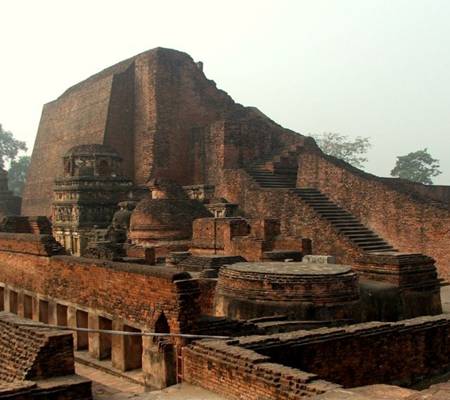
The Nalanda, located in the Indian State of Bihar, was a Buddhist center of learning from 427 C.E to 1197 C.E partly under the Pala Empire. It has been called "one of the first great universities in recorded history." According to historical studies the University of Nalanda was established 450 C.E under the patronage of the Gupta emperors, notably Kumaragupta. Nalanda, considered as the world's first residential university, had dormitories for students and had accommodated over 10,000 students and 2,000 teachers. The university was considered an architectural masterpiece, and was marked by a lofty wall and one gate. Nalanda had eight separate compounds and ten temples, along with many other meditation halls and classrooms. On the grounds were lakes and parks. The library was located in a nine storied building where meticulous copies of texts were produced. The subjects taught at Nalanda University covered every field of learning, and it attracted pupils and scholars from Korea, Japan, China, Tibet, Indonesia, Persia and Turkey. The Tang Dynasty Chinese pilgrim Xuanzang left detailed accounts of the university in the 7th century.
Lakshmana temple at Khajuraho, a panchayatana temple.Khajuraho Temple, India
Khajuraho has the largest group of medieval (between 950 C.E and 1050 C.E) temples of Hindu and Jain religion. There is perfect fusion of architecture and sculpture at this temple complex, famous for their erotic sculpture. The temples are a UNESCO world Heritage Site. At the Temple of Kandariya, there is a profusion of decorated sculptures considered as one of the greatest masterpieces of Indian art. Built by Chandela dynasty, the temples exhibit stunningly explicit sexual sculptures which were created by the artist's imagination of lovemaking positions prevalent at that time, or based on the rules outlined in the Kamasutra. Many of the sculptors have claimed artistic ownership on many sculptures. Built of sandstone in varying shades of buff, pink or pale yellow, most of the temples belong to the Shiva, Vaishnava or Jaina religious Sects, which are difficult to differentiate from one another. The temples, sited in an East-West direction, depicts a plan with spacious layout with interior rooms inter connected. An entrance, a hall, a vestibule and a sanctum are part the common layout plan of the temples. It is stated that the Khajuraho temples are a celebration of womankind, her innumerable moods and facets which are witnessed by the carvings of a woman writing letter, applying makeup to her eyes, combing her tresses, dancing, and playing with her child. Also etched, sculpted with consummate skill are innocent, coquettish, smiling, seductive, passionate and beautiful and erotic sculptures depicted in intricate detail. It is also opined that the Chandelas followed the Tantric cult with the faith that gratification of earthly desires is a step towards attaining Nirvana, the infinite liberation.
Thursday, January 20, 2011
Amazing facts about India
- The name `India' is derived from the River Indus, the valleys around which were the home of the early settlers. The Aryan worshippers referred to the river Indus as the Sindhu.
- The Persian invaders converted it into Hindu. The name `Hindustan' combines Sindhu and Hindu and thus refers to the land of the Hindus.
- The number system was invented by India. Aryabhatta was the scientist who invented the digit zero. More facts after the break...
- Sanskrit is considered as the mother of all higher languages. This is because it is the most precise, and therefore suitable language for computer software. ( a report in Forbes magazine, July 1987 ).
- Chess was invented in India.
- Algebra, Trigonometry and Calculus are studies which originated in India.
- The' place value system' and the 'decimal system' were developed in 100 BC in India.
- The first six Mogul Emperor's of India ruled in an unbroken succession from father to son for two hundred years, from 1526 to 1707.
- The World's First Granite Temple is the Brihadeswara temple at Tanjavur in Tamil Nadu. The shikhara is made from a single ' 80-tonne ' piece of granite. Also, this magnificient temple was built in just five years, (between 1004 AD and 1009 AD) during the reign of Rajaraja Chola.
- India is.......the Largest democracy in the world, the 6th largest country in the world AND one of the most ancient and living civilizations (at least 10, 000 years old).
- The game of snakes & ladders was created by the 13th century poet saint Gyandev. It was originally called 'Mokshapat.' The ladders in the game represented virtues and the snakes indicated vices. The game was played with cowrie shells and dices. Later through time, the game underwent several modifications but the meaning is the same i.e good deeds take us to heaven and evil to a cycle of re-births.
- The world's highest cricket ground is in Chail, Himachal Pradesh. Built in 1893 after levelling a hilltop, this cricket pitch is 2444 meters above sea level.
- India has the most post offices in the world !
- The largest employer in the world is the Indian railway system, employing over a million people !.
- The World's first university was established in Takshila in 700 BC. More than 10,500 students from all over the world studied more than 60 subjects. The University of Nalanda built in the 4th century was one of the greatest achievements of ancient India in the field of education.
- Ayurveda is the earliest school of medicine known to mankind. The father of medicine, Charaka, consolidated Ayurveda 2500 years ago.
- Although modern images & descriptions of India often show poverty, India was one of the richest countries till the time of British in the early 17th Century. Christopher Columbus was attracted by India's wealth and was looking for route to India when he discovered America by mistake.
- The art of Navigation & Navigating was born in the river Sindh 6000 over years ago. The very word 'Navigation' is derived from the Sanskrit word NAVGATIH. The word navy is also derived from the Sanskrit word 'Nou'.
- Bhaskaracharya rightly calculated the time taken by the earth to orbit the sun hundreds of years before the astronomer Smart. His calculations was - Time taken by earth to orbit the sun: ( 5th century ) 365.258756484 days.
- The value of "pi" was first calculated by the Indian Mathematician Budhayana, and he explained the concept of what is known as the Pythagorean Theorem. He discovered this in the 6th century, which was long before the European mathematicians.
- Algebra, trigonometry and calculus also orignated from India. Quadratic equations were used by Sridharacharya in the 11th century. The largest numbers the Greeks and the Romans used were 106 whereas Hindus used numbers as big as 10*53 ( i.e 10 to the power of 53 ) with specific names as early as 5000 B.C. during the Vedic period. Even today, the largest used number is Tera: 10*12( 10 to the power of 12 ).
- Until 1896, India was the only source for diamonds to the world. ( Source . Gemological Institute of America )
- The Baily Bridge is the highest bridge in the world. It is located in the Ladakh valley between the Dras and Suru rivers in the Himalayan mountains. It was built by the Indian Army in August 1982.
- Sushruta is regarded as the father of surgery. Over 2600 years ago Sushrata & his team conducted complicated surgeries like cataract, artificial limbs, cesareans, fractures, urinary stones and also plastic surgery and brain surgeries.
- Usage of anesthesia was well known in ancient India medicine. Detailed knowledge of anatomy, embryology, digestion, metabolism, physiology, etiology, genetics and immunity is also found in many ancient Indian texts.
Tuesday, September 1, 2009
India shines at Bastille Day parade
COLOURS OF A NATION
France's national colours trail over the Champs Elysees during the annual Bastille Day parade
WHITE STRIDE
An Indian military regiment marches as guests of honour at the head of the annual Bastille Day parade in Paris
FORCE INDIA
The Maratha regiment leads the Indian contingent on the Champs Elysees during the annual Bastille Day parade in Paris on July 14, 2009.
INDIA'S PRIDE
Indian army regiment marches on the Champs Elysees during the annual Bastille Day parade in Paris on July 14, 2009. Several army regiments were guests honour of this year.
The Maratha regiment led the 400 hundred soldiers from the Indian armed forces.
HONOURED GUEST
France's President Sarkozy greets wife of India's Prime Minister Gursharan Kaur during Bastille Day parade in Paris on July 14, 2009. France's first lady Carla Bruni-Sarkozy looks on.
ALWAYS FIRST
Carla Bruni-Sarkozy, the wife of France's President Nicolas Sarkozy, arrives at the Place de la Concorde in Paris on July 14, 2009 to attend the Bastille day parade.
THIS IS HOW WE DO IT
France's President Sarkozy speaks with India's Prime Minister Manmohan Singh(R)during the annual Bastille Day military parade in Paris on July 14, 2009.
INDO-FRENCH CONNECTION
France's President Nicolas Sarkozy (L) speaks to Indian Prime Minister Manmohan Singh as he arrives at the Place de la Concorde in Paris to attend the Bastille day parade on July 14, 2009.
GO FRANCE!
France's President Nicolas Sarkozy arrives at the Place de la Concorde prior to the Bastille day parade on the Champs Elysees in Paris on July 14, 2009.
My Blog List
-
The Vera Zvonareva Picture15 years ago
-
-
Deepika Padukone in Dum Maro Dum15 years ago
-
-
Happy new year SMS15 years ago
-
-
-